
How to Choose the Best Physiotherapist : the Complete Guide You Need

Knowing how to choose best physiotherapist can completely change the outcome of your recovery. With hundreds of clinics and therapists available today, making the wrong choice means wasted time, money, and continued pain. Whether you are dealing with chronic back pain, recovering from surgery, managing a neurological condition, or seeking cancer rehabilitation — the right physiotherapist makes all the difference. This complete guide walks you through every factor that matters — qualifications, experience, treatment methods, red flags, and the right questions to ask — so you can make a confident, informed decision from day one..
Written by: Dr. Shatbi , certified physiotherapist in Varanasi with 10+ years of clinical exposure to evidence-based physiotherapy, Oncology rehab, neuro rehabilitation, chiropractic and Sports Injury rehab. Before the end of this article, you will know exactly what to look for, which questions to ask and a big list of red flags that you should avoid – so that the first time you are making the right decision.
Table of Contents
1. Understand Your Needs First
But before you go hungry looking for ways to select the best physiotherapist in your town, define what is really necessary for you. TL; DR : Physical therapy is a diverse profession with several specialities. Another mistake is to seek out a person who treats ordinary musculoskeletal disorders when you really need neurological rehabilitation, or the other way around.
Ask yourself which one of two categories does your situation fall into?
• Sports injury rehab — ligament tears, muscle strains, fracture recovery
• Chronic pain management– back pain, neck pain, arthritis, fibromyalgia
• Recovery from, after knee replacement, spinal surgery, hip replacement
• Neurological conditions (ex: stroke, Parkinson’s disease, cerebral palsy, multiple sclerosis)
• Cancer rehabilitation — treatment-related fatigue, pain, lymphoedema
. Pediatric physiotherapy Devel- opmental delay, infant CP
. Geriatric physiotherapy (falling prevention, joint movement range for older patients)
Varanasi and its neighbouring districts — Chandauli, Jaunpur, and Mirzapur — have a unique mix of occupational profiles. A large number of residents work desk jobs in IT and government offices, while others are engaged in farming, construction, or physically demanding daily labour.
Both extremes — prolonged sitting and heavy physical work — are leading causes of chronic low back pain, cervical spondylosis, and knee joint problems in this region. Understanding your occupation, daily routine, and lifestyle is therefore an important first step in identifying the right type of physiotherapy care for your specific needs.
2. Check Qualifications and Certifications
This is non-negotiable. To be a Physiotherapist in India, one pursued at least a Bachelor of Physiotherapy (BPT) from an accredited institution. Most specialists go on to obtain a Master of Physiotherapy (MPT) from various streams such as orthopaedics, neurology, sports or cardiopulmonary physiotherapy
What to Verify:
- BPT or MPT degree from a UGC-recognised institution
- Registration with the Indian Association of Physiotherapists (IAP) or respective State Physiotherapy Council
- Additional certifications in specialised areas (e.g., Mulligan Technique, McKenzie Method, Bobath Neurological Rehabilitation, Kinesio Taping)
- Membership with World Physiotherapy (world.physio) affiliated organisations
- Ongoing professional development through workshops and courses
According to World Physiotherapy guidelines, physiotherapists are autonomous health professionals and should be registered with a recognised professional body in their country. In India, the IAP serves as the primary professional organisation. Always ask your physiotherapist to confirm their registration status before beginning treatment.
3. Evaluate Experience and Specialisation
Experience matters enormously in physiotherapy. A therapist has clinically reasoned with hundreds of patients with your specific condition so that they have clinical reasoning skills beyond what you can learn from textbooks.
When evaluating experience, consider:
- Years since active clinical practice (not years of graduation) ,
How to Achieve Level 4 of Your Field
• Working with patients that have your condition
• If they are able to share broad outcomes or types of case they frequently treat
• Specialized areas of expertise — sports rehab, neuro rehab •
• If they constantly keep their skills updated by enrolling in continued education
Selecting a specialist with relevant experience makes a significant difference in your recovery. For example, cancer rehabilitation requires specific knowledge of treatment side effects, lymphoedema management, and post-treatment fatigue — not every general physiotherapist is trained for this.
Dr. Shatbi at shatbipaincare.com specialises in exactly these areas, including oncology rehab, neurological physiotherapy, and sports injury recovery, ensuring that your treatment plan is built around your specific condition — not a generic protocol.
4. Research Reputation: Reviews, Referrals, and Real Stories
Everyone wants to know about a physiotherapist it takes just minutes to find out. So do your research before you go in for that first appointment.
- Google Reviews and ratings: Aim for minimum 4-star ratings consistently or other patients say regarding their treatment
• Testimonials on the clinic website: Authentic testimonials generally name a condition and describe treatment accomplishments.[https://shatbipaincare.com/testimonials]
• Referrals — Speak to your family doctor, orthopaedic doctor, or relatives
• Hospital referrals; Lots of hospitals will refer patients to physiotherapists that they trust for rehabilitation after discharge
• Active social media: Active educational presence indicates a practitioner with the latest developments in his/her area
Beware of clinics with only a few recent reviews, or uniformly vague praise. Authentic reviews often reference the therapist by name, type of condition treated and specific improvements seen.
5. Assess Treatment Methods and Evidence-Based Practice
This is the first mistake that many patients make. There are different approaches to physiotherapy. World Physiotherapy, and the Indian Association of Physiotherapists (IAP), recommend evidence-based practice — where treatment decisions are made based on best available clinical research, therapist expertise and patient values.
Effective Treatment Methods Include:
- Manual therapy: including Joint mobilisation Soft tissue techniques Spinal manipulation (chiropractic-style adjustments performed by trained therapists)
Therapeutic exercise prescription: individually progressed strengthening, stretching and functional movement programs
• Electrotherapy modalities : TENS, Ultrasound therapy, IFT (Interferential Therapy), Laser therapy
• Dry needling & acupuncture (for trained practitioners)
• Bobath, PNF— techniques for neurological rehabilitation
• Home Exercise Programmes – a hallmark of quality physiotherapy is always giving the patient exercises to do when they go home
Never trust clinics that only use passive treatment (heat, ultrasound, TENS) without any active rehab exercises. International physical therapy organisations, including the UK-based Chartered Society of Physiotherapy (CSP) and World Physiotherapy have also published guidelines consistently recommending active, exercise-based rehabilitation as key long-term management strategies.
6. Communication, Comfort, and Trust
A physiotherapist may be great at his job, but if he cannot explain things to you in a manner that you understand, then you will not recover. This applies particularly for patients from Varanasi, Banaras Hindu University area, and the adjacent parts of Uttar Pradesh, Bihar, and Jharkhand who may not understand English at all or would like a mix of Hindi or some regional dialect along with medical terms.
Look for a physiotherapist who:
- Addresses your diagnosis and treatment plan (in simple, clear language)
• Listening to your concerns and modifying the plan
• Sets realistic goals and timeframes — not miracle promises;
• Gives relaxed hands-free treatment
• Contains written home exercise instructions
• Keeps you updated on your progress and adjusts treatment as necessary
Trust your instincts. When your first session leaves you more confused, feeling dismissed or uncomfortable, seek a second opinion.
7. Check Clinic Facilities and Hygiene Standards
Hygiene and infection control in physiotherapy clinics have taken a new turn today due to COVID. As you go in for a first visit — or even browsing through the photos of the clinic online, consider the following:
- Change treatment beds for each patient with clean linen
• Cleaning exercise machines, ultrasound probes, TENS pads by the therapist before each patient
• Proper spacing and ventilation between treatment services
• Availability of new-age rehabilitation facilities
• Waiting room separated and seamless appointment
• Elderly, post-surgical or differently-abled patients (ramps, wide doors, ground-floor access)
At shatbipaincare.com, Dr. Shatbi maintains a fully equipped physiotherapy clinic in Varanasi with modern rehabilitation instruments and strict hygiene protocols.
Home visit physiotherapy services are also available for patients unable to travel — including post-surgical patients, stroke survivors, and cancer patients on home-based care.
Learn more about Home Physiotherapy Services at shatbipaincare.com
8. Compare Cost, Insurance, and Value for Money
Cost is always a factor, particularly in places such as Tier-2 cities like Varanasi, where healthcare expenditure is an important household decision. But the budgeting option almost never pays off for your recovery. The correct way to assess cost is as follows:
- Request a clear fee schedule: per session fees, package plans and introductory assessments.
• Ask if they are on your insurance panel (Some clinics accept Ayushman Bharat or CGHS)
• What is included in each session (hands on treatment times vs machine times)
• Match session length_First and foremost, there is a huge difference in one_20 minutes session from customizing another 45 minute therapist assistance
• Ask if they do home visits, and how much that costs.
Physiotherapy value for money is not only about session cost — it is about the number of sessions required and how soon you recover. Any physiotherapist that can deliver results within 8 sessions is always going to work out cheaper than an average one that keeps sending you back for 20 sessions where improvement is difficult to show.
9. Location, Availability, and Convenience
When searching for how to choose the best physiotherapist near me, proximity and scheduling flexibility matter — especially for conditions requiring multiple sessions per week.
- Select a clinic close enough to your home or work
- Verify about flexible timings during early mornings or evenings for working patients
- Inquire about weekend or emergency availability for acute injuries vs. post-operative complications
- Check if follow up sessions are available for online physiotherapy consultations or tele rehabilitation
- Citizens of Varanasi: Attempt to remain in or around significant regions like Lanka, Sigra, Assi or Lahurabir as far as comfort
10. Essential Questions to Ask Before You Decide
Prior to working with a physiotherapist, book an introductory session and ask these questions. Their responses are going to tell you a lot about their clinical expertise and style:
1. How long have you been practicing and what conditions do you treat?
2. What treatment method will you use and why?
3. How long do you estimate my recovery will take?
4. What exercises can I do at home between sessions?
5. How will you track and measure my progress?
6. What activities should I avoid during my recovery?
7. What happens if I don’t see improvement after a few sessions?
11. Practical Exercise and Therapy Plan to Discuss With Your Physiotherapist
A Most good physiotherapists will divide your plan into phases. A Typical Recovery Program is as Follows- and What You Should Expect at Each Level
- Phase 1 — Pain Control and Protection (Week 1–2): Manual therapy, gentle range-of-motion exercises, posture/movement education, ice/heat as needed
• Phase 2 — Restoring Movement (Week 2–4): Gradual stretching, joint mobilisation, low-load strengthening, ergonomic advice for those spending substantial time at a desk • Phase three — Strengthening and Functional Training
• Phase 3 — Strength and Function (Week 4–8): Periodized strength training, functional movement patterns, sport or task specific training
• Phase 4 — Return to Activity (Week 8+): Full functional rehabilitation, prevention strategies, home maintenance programme
Make sure you always get a written home exercise programme from your physiotherapist. Patients who practice exercises between sessions continue to perform better than those relying simply on clinic sessions — a conclusion that receives consistent support in physiotherapy evidence through musculoskeletal, neurological and postoperative conditions.
Do’s and Don’ts When Choosing a Physiotherapist
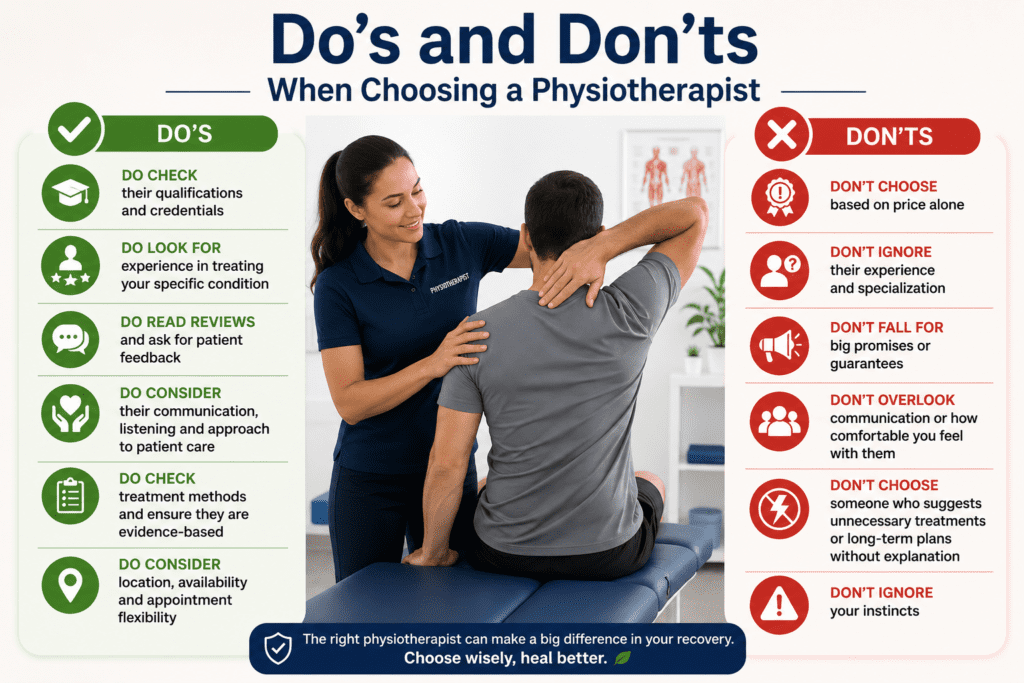
Do’s
- Do check professional credentials and registration
- Do schedule an initial consultation before committing to a full course
- Do ask about their specific experience with your condition
- Do look for personalised, progressive treatment plans
- Do compare at least 2–3 physiotherapists before deciding
- Do trust your comfort level during the first session
Don’ts
- Don’t choose based on price alone
- Don’t accept a one-size-fits-all treatment plan with no individual assessment
- Don’t ignore a physiotherapist who promises unrealistically fast cures
- Don’t continue with a therapist who dismisses your pain or concerns
- Don’t delay seeking physiotherapy — early treatment almost always leads to better recovery
- Don’t skip your home exercises between sessions
12. Red Flags to Watch Out For
Question your choice if you find any of the below:
- No professional certification or degree to back it up that is verifiable
• Pressure to purchase long packages upfront prior to a formal evaluation
• A ‘Standard package’ offered (given/provide) to all patient irrespective of the condition
Days of being ‘cured fully’ — not how recovery works
• Inconsistent poor cleanliness and facilities that seem old and not well-kept
• Dismissive tone or not taking the patient’s history
• Bad or still-clear feedback on the web mentioning that unprofessional behavior
13. Making the Final Decision: Tips From a Physiotherapist
The best decision combines clinical evidence with your personal
comfort and instinct. Here is a simple 6-step framework:
Step 1: Shortlist 2–3 physiotherapists based on
certification, reviews and expertise
Step 2: Call each clinic and ask the key questions
listed in Section 10
Step 3: Book only a first consultation — not a full course
Step 4: Evaluate the quality of the initial assessment —
a good physiotherapist will spend time understanding your
history before suggesting any treatment
Step 5: Assess how comfortable you felt and how clearly
they communicated the treatment plan
Step 6: Make your final decision based on all of the above
— not just price or location alone
Frequently Asked Questions (FAQs)

People Also Ask — real questions searched by patients across India and Varanasi:
Q1. What does a physiotherapist do?
Physiotherapy is the assessment, diagnosis and treatment of conditions affecting physical movement, function and/or quality of life. They utilize a blend of manual hands-on therapy, therapeutic exercise, electrotherapy and patient education to facilitate rehabilitation from illness or injury recovery-oriented care on acute neck and back pain among others Physiotherapists do not prescribe medications or conduct surgery as orthopaedic doctors, instead their tools are movement and rehabilitation. An important part of long-term recovery is teaching patients how to control their own condition throughout time, something that a physiotherapist really takes pride in doing.
Q2. How many sessions does physiotherapy take?
We train you for the number of sessions depending on your condition, severity, how long it has been there and your overall health. For acute conditions — generally a recent muscle strain or minor sports injury — recovery can occur within 4 to 6 treatments. Chronic conditions such as post-stroke rehabilitation, post-surgical recovery or chronic back pain may need 12–20 or more sessions over a number of weeks. An appropriate assessment made by a qualified physiotherapist will provide you with an estimated timeline that is practical. If the first one cannot even offer you a ballpark figure,run!
Q3. Is physiotherapy painful?
Physiotherapy can be slightly painful, especially during deep tissue work, joint mobilisation or when tight muscles are being stretched. That being said, it shouldn’t be excruciating. It is a principle of experienced physiotherapists to work within tolerance — it is ok for it to be uncomfortable but sharp or worsening pain during the treatment and afterwards causes you to change course. Always communicate with your physiotherapist about the levels of pain you are experiencing. What they often say when it comes to rehabilitation:No pain, no gain is a myth — You should be progressing at a pace that you can sustain in the time between visits.
Q4. What is the difference between a physiotherapist and an orthopaedic doctor?
Orthopaedic medicine/orthopaedic surgery is a medical doctor (MD) and surgeon (orthopaedic surgeon), which is involved in diagnosis and surgical management of various orthopedic conditions including bone, joint, or musculoskeletal disorders. Physiotherapist provides non-surgical rehabilitation services to restore normal movement and function. However, in many situations, therice the two work hand-in-hand; an orthodontic doctor carries out a surgery or medication and after that a physiotherapist oversees completing rehabilitation and recovery. You are the key essential and necessary members to care team that do not replace the other.
Q5. Can physiotherapy be done at home?
Sure — home physiotherapy is a completely accepted and safe method for patients unable to travel to the centre. Such patients include those recovering from surgery, stroke survivors, the elderly and individuals who are bedridden due to cancer treatment. It is only when a qualified physiotherapist conducts home visits that person to person interaction can take place easing the patient in their own surroundings. Dr. Shatbi at shatbipaincare. TheHomePhysio Has Home Physiotherapy Services In Varanasi and surrounding areas Not every condition can be treated at home and some patients are best served by accessing specialist equipment in a clinic — your physiotherapist will guide you about this.
Q6. Is physiotherapy covered by health insurance in India?
In India some health insurances do provide physiotherapy coverage but this can differ from policy to policy and provider to a provider. Only certain Government schemes (such as Ayushman Bharat (PM-JAY), CGHS- Central Government Health Scheme, etc.) may provide some physiotherapy services under limited circumstances. Physiotherapy is part of other hospitalisation packages or post-surgical rehabilitation packages offered by private health insurers like Star Health, HDFC ERGO and others? Before you start a treatment programme, it is wise to check your individual policy documents or consult your insurer directly to make sure you know what parts are covered.
Conclusion: Make the Right Choice for Your Recovery
How to choose the best physiotherapist is one of the biggest steps you will need to take on your road to recovery. From verifying the credentials and experience of doctors, gauging their communication skills to understanding treatment procedural — everything in this guide is made for you to help you assess and make an informed, confident decision.
Do not opt for convenience only ⬅️ The right physiotherapist will listen to your story, approach you as a unique individual currently in need of help and develop an achievable plan with you for long term health. Whether you are recovering from surgery, or suffering managing chronic back pain after years of desk work, a neurological condition requiring physical therapy for cancer rehabilitation — this guide contains the principles that will be useful in your case, no matter what.
Ready to begin your recovery?
Book a private physiotherapy consultation with Dr. Shatbi — the best physiotherapist in Varanasi.
📍 Tarna, Near Ganeshpur Railway Crossing, Varanasi
📞 Call or WhatsApp: 9918228288
🌐 Book Online: shatbipaincare.com.
Disclaimer: This content is for informational purposes only and should not replace professional medical or physiotherapy advice. Please consult a qualified physiotherapist or doctor before beginning any exercise or treatment program.
About the Author: This article is reviewed and written by Dr. Shatbi, a certified physiotherapist in Varanasi with specialised expertise in cancer rehabilitation, neurological physiotherapy, sports injury recovery, and chiropractic treatment. Dr. Shatbi practises at shatbipaincare.com and is available for in-clinic and home-visit physiotherapy consultations across Varanasi and the surrounding region.