
Picture this — you wake up in the morning and the very first thing you feel is that familiar ache in your back. Getting out of bed feels like a task. Putting on your shoes feels difficult. Even sitting down for chai becomes uncomfortable.
Sound familiar? You are not alone in this.
Back pain is incredibly common. It is one of the top reasons people in Varanasi and across UP and Bihar miss work or struggle through a normal day. We see it every day at our clinic — teachers who sit for 6 to 7 hours at a stretch, auto and rickshaw drivers who deal with constant jolts and vibrations, students hunched over mobile phones for hours. Back pain does not choose anyone. It can happen to anyone, at any age.
Here is the good news — you do not always need surgery or a lifetime of painkillers. With the right physiotherapy, the right exercises, and some simple lifestyle changes, most people get meaningful relief. Real relief.
At Shatbi Pain Care, Varanasi, Dr. Shatbi offers specialized physiotherapy for back pain in Varanasi — helping hundreds of patients get their life back through personalized, science-backed treatment.— a certified back pain physiotherapy specialist in Varanasi with expertise in bone, nerve, and rehabilitation care — has helped hundreds of patients get their life back through personalized, science-backed treatment.
In this guide, you will learn: what is actually causing your back pain, which warning signs you must never ignore, simple exercises that genuinely help, how professional physiotherapy works, and how to keep the pain from coming back.
1. Say Good bye to Back Pain : A Complete Guide by Varanasi’s Specialist in Back Pain Physiotherapy .
Before we talk about relief, let us understand what is going on. Your spine is made up of 33 small bones (called vertebrae), cushion-like discs between them, muscles, ligaments, and nerves. When any part of this gets stressed or damaged — pain begins.
Acute vs. Chronic Back Pain
-
- Acute back pain: Comes on suddenly. Usually lasts less than 6 weeks. Often from a muscle pull or minor injury.
-
- Chronic back pain: Pain that has been around for more than 3 months. This usually means something deeper — like a disc problem or nerve pressure.
Where Does It Hurt?
-
- Lower back: The most common area. Makes sitting, bending, and walking painful.
-
- Middle back: Usually linked to posture problems or long hours at a desk.
-
- Upper back and neck: Very common among Varanasi’s young working population — people who use phones or computers for hours every day.
2. What Is Causing Your Back Pain?
Understanding the root cause is the first step to real treatment. Here are the most common reasons we see at our clinic:
-
- Poor sitting or standing posture — very common among office workers and students
-
- Sitting still for too long with no breaks or movement
-
- Muscle strain from sudden movements, lifting wrong, or overdoing physical work
-
- Slip disc (when the soft cushion between bones presses on a nerve)
-
- Stress and mental tension — yes, this tightens your back muscles too
-
- Arthritis or age-related wear and tear of the spine
-
- Long hours on a smartphone or laptop in a bad position
-
- Sleeping in a wrong position or on a mattress that is too soft
3. Warning Signs You Should Never Ignore
Some back pain is just sore muscles. But certain signs mean you need to see a professional right away. Please do not wait if you notice any of these:
⚠️ WARNING SIGNS — See a Doctor Immediately:
🔴 Pain that has not improved in 2 to 3 weeks
🔴 Numbness or tingling going down your legs or feet
🔴 Sharp pain shooting down one or both legs (this could be sciatica)
🔴 Weakness in your legs or trouble walking
🔴 Loss of control over bladder or bowel — this is a medical emergency
🔴 Back pain after a fall, accident, or injury
🔴 Fever along with back pain — may point to an infection
We once had a patient from the BHU area who had a burning pain running from his lower back all the way down to his foot. He had been ignoring it for months, thinking it was just a normal backache. When we examined him, he had serious pressure on his sciatic nerve. Early physiotherapy helped him avoid surgery. Please — do not delay.
4. Daily Habits That Are Silently Hurting Your Back
Here is the thing — most back pain does not come from a single big injury. It builds up slowly, day by day, because of small habits. Watch out for these:
Sitting Habits
-
- Sitting for more than 45 to 60 minutes without a break
-
- Slouching forward or leaning to one side
-
- Crossing your legs habitually while sitting
Phone and Screen Use
-
- Looking down at your phone for long periods — this is called ‘text neck’
-
- Working on a laptop that is placed too low on the table
Lifting and Movement
-
- Bending from the waist instead of your knees when picking things up
-
- Carrying heavy bags on just one shoulder
Sleep Posture
-
- Sleeping on your stomach — this puts unnecessary pressure on your lower back
-
- Using a pillow that is too high, or a mattress that is too soft
5. Simple Exercises That Can Help Ease Your Back Pain
According to global physiotherapy guidelines, structured exercise is one of the most effective ways to treat both new and long-term back pain. These exercises are gentle and suitable for most adults.
Important: Please check with your physiotherapist before starting. Stop immediately if any exercise increases your pain. Start slow.
A. Stretching Exercises
-
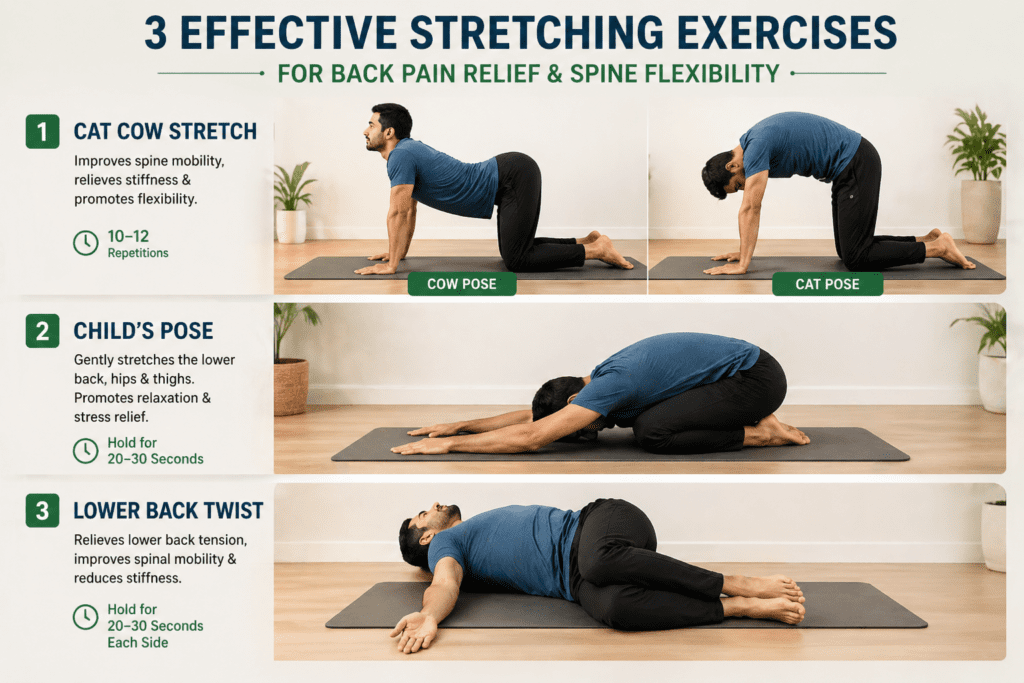
- Cat-Cow Stretch: Go on all fours. Arch your back up like a cat, then let it dip down like a cow. Repeat 10 times. This loosens your whole spine.
-
- Child’s Pose: Sit back on your heels and reach your arms forward on the floor. Hold for 20 to 30 seconds. Gently stretches your lower back.
-
- Knee-to-Chest Stretch: Lie on your back. Pull one knee gently toward your chest. Hold for 20 seconds. Switch legs. Relieves tension in the lower back.
B. Core Strengthening Exercises
-
- Pelvic Tilts: Lie on your back with knees bent. Gently press your lower back flat against the floor. Hold for 5 seconds. Repeat 10 to 15 times.
-
- Dead Bug: Lie on your back. Arms pointing up, knees bent at 90 degrees. Slowly lower one arm and the opposite leg toward the floor. Come back. Alternate. 8 to 10 reps per side.
-
- Bridge: Lie on your back with knees bent. Lift your hips off the floor. Hold for 5 seconds. 10 to 12 reps. Strengthens your lower back and hips.
A 2021 review published in the British Journal of Sports Medicine found that combining stretching and core exercises significantly reduces long-term back pain. Even 15 to 20 minutes a day, done consistently over 4 to 6 weeks, makes a real difference.
6. Posture Correction Tips That Actually Work
Bad posture is both a cause and a result of back pain. Fixing it takes a little daily effort — but the long-term benefit is absolutely worth it.
At Your Desk or Workstation
-
- Keep your back straight with your lower back supported by the chair
-
- Feet flat on the floor, knees at a 90-degree angle
-
- Computer screen at eye level — not tilted up or down
-
- Elbows close to your body, forearms parallel to the floor
-
- Take a 5-minute standing or walking break every 45 to 60 minutes
While Standing
-
- Put your weight evenly on both feet — do not lean to one side
-
- Gently engage your core muscles, as if you are bracing yourself
-
- Do not lock your knees or push your hips forward
Ergonomic Tips for Home and Office
-
- Use a lumbar support cushion if your chair does not support your lower back
-
- If you work from home — invest in a proper ergonomic chair. It is worth it
-
- Use a laptop stand or a stack of books to raise your screen to eye level
7. Home Remedies and Lifestyle Changes That Support Recovery
Heat and Cold Therapy
-
- Cold (ice pack wrapped in cloth): Best in the first 24 to 72 hours after an injury. Helps reduce swelling. Apply for 15 to 20 minutes.
-
- Heat (warm water bottle or heating pad): Best for ongoing muscle tightness. Relaxes muscles and improves blood flow.
-
- Never apply ice directly to bare skin. Do not use heat on a fresh injury.
Massage and Relaxation
-
- Gentle self-massage of your lower back and hips can ease muscle tension
-
- Mindfulness, deep breathing, and yoga-based relaxation have been shown in studies to reduce long-term back pain
Lifestyle Changes That Make a Big Difference
-
- Stay active: Even a 20 to 30 minute daily walk keeps your back muscles and joints moving
-
- Manage your weight: Extra weight around the belly puts more pressure on your lower back
-
- Drink enough water: The discs in your spine are mostly water — staying hydrated keeps them healthy
-
- Quit smoking: Studies show smoking reduces blood supply to spinal discs, making them age faster
8. Professional Physiotherapy for Back Pain in Varanasi
When home exercises are not enough — professional physiotherapy goes much deeper.
This is exactly why physiotherapy for back pain in Varanasi at Shatbi Pain Care is designed to go beyond surface-level relief.
What Your First Visit at Shatbi Pain Care Looks Like
Your first session begins with a detailed assessment. Back pain specialist Dr. Shatbi will look at your posture, how freely you can move, your muscle strength, any nerve-related signs, and how your pain is affecting your daily life. Only then is your personalized treatment plan designed — because no two backs are the same.
Treatments We Offer
-
- Manual Therapy: Hands-on joint and muscle techniques to reduce pain and restore movement — no medicines involved
-
- Exercise Therapy: A personalized program combining core strength, flexibility, and functional training
-
- Electrotherapy: TENS (electrical nerve stimulation), ultrasound therapy, and IFT (interferential therapy) for targeted pain relief
-
- Postural Re-education: Practical coaching on how to sit, stand, sleep, and move without hurting your spine
-
- Dry Needling / Trigger Point Release: A targeted technique to release stubborn muscle knots that cause referred pain
-
- Chiropractic Techniques: Spinal adjustment offered as part of integrated care where appropriate
Home Visit Physiotherapy — Available Across Varanasi
Cannot travel due to severe pain, post-surgery recovery, or another health condition? We come to you. Shatbi Pain Care offers professional home visit physiotherapy across Varanasi. Dr. Shatbi and the team bring the right equipment and expertise directly to your home.
Learn more at shatbipaincare.com
Your Step-by-Step Recovery Plan
-
- Week 1–2: Pain management — electrotherapy, manual therapy, rest guidance, and gentle movement
-
- Week 3–4: Flexibility and mobility — stretching, joint mobilization, walking program
-
- Week 5–8: Core strengthening and rehabilitation — progressive exercises, posture training
-
- Ongoing: Prevention — home exercise plan, lifestyle guidance, and periodic check-ins
9. Back Pain Do’s and Don’ts — A Practical Guide
| ✅ DO These | ❌ AVOID These |
| ✔ Stay gently active; avoid complete bed rest | ✖ Ignore pain that spreads to your legs |
| ✔ Apply heat or cold therapy as appropriate | ✖ Lift heavy objects with a rounded back |
| ✔ Bend your knees when picking things up | ✖ Sit or lie in one position for hours |
| ✔ Sleep on your side with a pillow between knees | ✖ Self-medicate with painkillers long-term |
| ✔ See a physiotherapist early — do not wait | ✖ Try high-impact exercises without guidance |
| ✔ Follow your prescribed exercise plan | ✖ Sleep on your stomach |
| ✔ Take regular breaks from sitting | ✖ Skip physiotherapy sessions mid-treatment |
| ✔ Maintain a healthy weight | ✖ Apply ice directly to bare skin |
10. Prevention Tips: Keep Your Back Healthy for Life
Treating back pain is important. But keeping it from coming back — that is the real goal. These habits will protect your spine long-term:
-
- Follow a daily stretching routine — even 10 minutes every morning makes a real difference
-
- Walk, swim, or cycle regularly — these are low-impact activities that are excellent for your back
-
- Always use the correct lifting technique — bend your knees, keep the load close, never twist while lifting
-
- Set reminders to take a screen break every 45 to 60 minutes
-
- Schedule periodic check-ups with your physiotherapist — especially if you have had back pain before
-
- Strengthen your core through yoga, Pilates, or guided exercise therapy
-
- Use a medium-firm mattress — most spine health guidelines recommend this for a good night’s rest
11. Frequently Asked Questions (FAQs)
.Q1. Is physiotherapy effective for back pain in Varanasi?
Yes — physiotherapy for back pain in Varanasi at Shatbi Pain Care is globally recognized as one of the most effective, evidence-based treatments.. At Shatbi Pain Care, many of our patients report significant improvement in pain and daily life within 4 to 8 weeks of consistent treatment. Results depend on how serious your condition is and how regularly you follow the plan.
Q2. How many sessions will I need?
It depends on whether your pain is new or long-standing. For newer back pain, some patients feel better in just 3 to 6 sessions. For long-term or chronic back pain, a more complete program of 12 to 20 sessions spread over several weeks usually works best. We will give you a clear estimate after your first assessment.
Q3. Can physiotherapy permanently cure back pain?
Here is an honest answer — physiotherapy cannot ‘cure’ structural issues like disc degeneration. But the evidence clearly shows it can significantly reduce pain, improve your ability to do daily activities, and prevent the pain from coming back — especially when you keep up with your home exercises and posture habits. Many of our patients achieve long-term, lasting relief. That is a meaningful outcome.
Q4. When should I see a physiotherapist instead of just resting?
Rest is fine for the first 1 to 2 days after a sudden injury. But if your pain is not getting better after 3 to 5 days, is getting worse, is spreading to your legs, or is making daily tasks difficult — please come in. The earlier you get help, the faster and more complete your recovery tends to be.
Q5. Does Shatbi Pain Care offer home visits in Varanasi?
Yes. If you cannot come to the clinic due to severe pain, limited mobility, or post-surgical recovery — we come to you. Shatbi Pain Care provides professional home visit physiotherapy services across Varanasi. To book a home visit, call 9918228288 or visit shatbipaincare.com.
The Bottom Line: Take Control of Your Back Health Today
Back pain can quietly take over your life — your sleep, your work, your mood, your ability to enjoy small everyday moments. We know how much it can wear you down.
But here is what we have seen with hundreds of patients — the right combination of exercises, posture correction, lifestyle changes, and professional physiotherapy works. Most people can manage their back pain meaningfully and get back to living well.
The key is not to ignore it. Do not wait for it to become severe. Early action almost always leads to better outcomes.
Evidence-based physiotherapy, guided by an experienced specialist, offers a safe and lasting path to relief — without surgery, without dependence on painkillers.
📞 Visit: Best Physiotherapist in Varanasi — Shatbi Pain Care
at Shatbi Pain Care, Varanasi.
Call: 9918228288
Visit: shatbipaincare.com
In-clinic and home visit physiotherapy available across Varanasi.
⚠️ Medical Disclaimer:
This content is for informational purposes only. It is not a substitute for professional medical advice, diagnosis, or treatment. Please consult a qualified physiotherapist or doctor before starting any rehabilitation program. Do not stop any prescribed medications or medical treatments without consulting your doctor.
About the Author
This article is reviewed by Dr. Shatbi, a certified physiotherapy specialist for back pain in Varanasi, with expertise in orthopaedic, neurological, and cancer rehabilitation at Shatbi Pain Care. With over a decade of clinical experience, Dr. Shatbi has helped hundreds of patients across Varanasi, UP, and Bihar get lasting back pain relief through expert physiotherapy — restoring movement, strength, and quality of life with evidence-based care.